


Audiology
Vol. 46: Issue 1 - February 2026
Early detection of hearing loss in older adults: the public audiology service in Italy, 2021-2023
Authors
Luciano Bubbico
 , Federica Di Berardino
, Giorgia Pugliese
, Valeria Caragli
, Salvatore Ferlito
, Elisabetta Genovese
, Diego Zanetti
, Luca Cegolon
, Lorenzo Pignataro
, Federica Di Berardino
, Giorgia Pugliese
, Valeria Caragli
, Salvatore Ferlito
, Elisabetta Genovese
, Diego Zanetti
, Luca Cegolon
, Lorenzo Pignataro
Summary
Cover Image
Objective. With the rise in life expectancy and increased age-related hearing loss (ARHL), audiological assessment is essential to enable prevention of cognitive decay associated with social isolation. This study evaluates audiological services in Italy to support future research, prevention strategies, and public health policies.
Methods. We analysed national audiological service data in Italy from 2021 to 2023, focusing on the use of pure-tone and speech audiometry. Service provision was examined in relation to population size, estimated ARHL prevalence, and availability of specialised personnel.
Results. The number of pure tone audiometry tests rose from 634,996 in 2021 to 790,245 in 2023; speech audiometry tests increased from 179,279 to 230,008, respectively. The national prevalence of pure-tone and speech audiometry tests performed in 2023 was 1340.1 x 100,000 and 390 x 100,000, respectively. Delivery of audiometry tests varied by area, with the North-East exhibiting the highest prevalence of speech audiometry tests in 2023, whereas pure tone tests were more more prevalent in the North-West of the country. The availability of audiology professionals was limited, with a just 2.16 consultant medical audiologists and 1.82 technicians per 100,000 residents.
Conclusions. The supply of audiology tests perfomed in Italy during 2021-2023 was insufficient to meet the growing demand for hearing assessments among the aging population. However, the effectiveness of any screening audiological programme depends not only on the availability of well-trained specialists, but also on effective education programmes for the general population.
Introduction
The current global increase in life expectancy has led to an increasingly aging population, with serious challenges arising for public health policies to plan adequate prevention and care strategies for the elderly. Among sensory functions, hearing is the one that deteriorates most significantly with aging 1. Age-related hearing loss (ARHL) leads to a drastic reduction in daily and social activities, resulting in reduction of autonomy, social exclusion, isolation 2, and cognitive decline, which may lead to dementia 3-5, conditions considered public health priorities by the World Health Organization (WHO) 4-6.
In Italy, dementia affects about 1 million people, while another 900,000 suffer from mild cognitive impairment. The socioeconomic impact is enormous, as nearly 3 million people (including family members and caregivers) are involved in the care of these patients 6. Audiological tests may therefore be useful in clinical assessment and in identifying patients at risk of cognitive impairment 7, thereby enabling prevention 8. Clinical hearing assessments are primarily based on pure tone audiometry and speech audiometry, traditionally performed manually by hearing specialists (consultant medical audiologists or audiologist technicians) 9. The first signs of hearing loss are usually reported by patients as difficulty in understanding speech, especially in noisy environments 10. Speech audiometry thus plays a crucial role to help identify early cognitive impairment in the elderly 11.
The aim of this study was to assess the supply audiology services in Italy in relation to the population needs.
Materials and methods
Data sources
Healthcare service data were collected from the National Agency for Regional Health Service (AGENAS) database on outpatient specialist services performed in Italy in 2021, 2022, and 2023. The AGENAS data do not report an estimated proportion, but instead provide the actual total number of tests performed by each region. We extracted and analysed data related to diagnostic outpatient activities in the field of Audiology, focusing on facilities and Audiology Services operating within the Italian National Health Service (SSN) and publicly funded private institutions. Specifically, we analysed procedures related to sensory functions by extracting hearing evaluation tests.
Diagnostic tests
We focused on first-level diagnostic exams necessary to identify hearing function: “pure-tone audiometry” and “speech audiometry”.
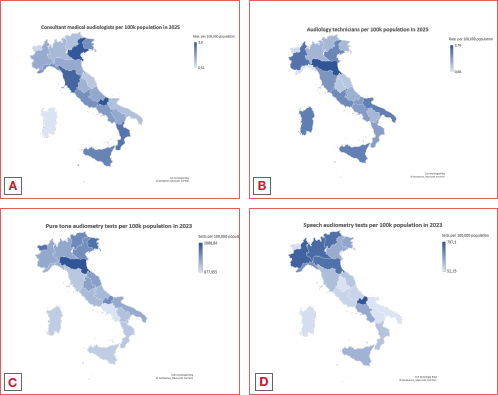
Data concerning healthcare professionals for year 2025 were collected from the National Federation of the Orders of Physicians and Dentists (FNOMCeO) for medical doctors trained in Audiology and Otoneurology (consultant medical audiologists), and from the National Federation of the Orders of Technical Health Professions (FNOTSRM-PSTRP) for “audiology technicians”. The number and regional distribution of professionals are shown in Cover figure and Table I.
To assess whether the demand for Audiology services is fulfilled across the territory, we considered the following parameters:
- frequency distribution of the Italian population on 31 December 2023, by region;
- estimated prevalence of ARHL;
- regional number of either types of audiometry tests performed per 100,000 population;
- regional prevalence of registered consultant medical audiologists and techincians per 100,000 population in 2025.
The size of the elderly population (i.e., individuals over 65 years) was also considered to estimate the future demand for audiological services.
Statistical analysis
The statistical analysis was performed using Stata 16.1 (Stata corporation, College station, Texas, USA) and Microsoft Excel. The study was conducted in accordance with the Strengthening the Reporting of Observational Studies in Epidemiology (STROBE) Statement: guidelines for reporting observational studies, and is part of the study approved by the Ethical Committee of the University of Milan (IRB approved 10.12.24).
Current data from 2023 were compared with those from 2021 and 2022 through a descriptive analysis. The main variables analysed and compared were the regional prevalence of pure tone and speech audiometry tests performed. Prevalence was examined across 5 major geographical areas: North-West (Piedmont, Aosta Valley, Lombardy, and Liguria), North-East (Trentino Alto Adige, Veneto, Friuli Venezia Giulia, and Emilia Romagna), Central (Tuscany, Umbria, Marche, and Lazio), South (Abruzzo, Molise, Campania, Calabria, Basilicata, and Apulia), and Islands (Sardinia and Sicily). Linear correlation was tested between the regional prevalence of consultant medical audiologists or technicians and the regional prevalence of either type of audiometric tests delivered.
Results
A nationwide increase in audiological services was recorded from 2021 to 2023 in Italy (Fig. 1A-B). In particular, for pure-tone audiometry, 634,996 tests were recorded in 2021, increasing to 705,990 in 2022, and 790,245 in 2023.
Similarly, for speech audiometry 179,279 tests were recorded in 2021, increasing to 206,637 in 2022 and 230,008 in 2023.
However, a significant difference in the prevalence of pure-tone and speech audiometry tests was found across the country (Fig. 2A-B). Based on the Italian population on 31 December 2023 (equal to 58,971,230 inhabitants, according to the Italian National Institute of Statistics [ISTAT] 12):
- 1340.1 pure-tone audiometry tests were conducted per 100,000 inhabitants.
- 390 speech audiometry tests per 100,000 inhabitants.
The latter discrepancy reflects the specific role of speech audiometry, which is mainly used for diagnosing central hearing loss in the elderly. Interestingly, speech audiometry exams represent 22.5% of the total audiometric tests, which aligns with the proportion of elderly residents in Italy (24.1%) 12.
The analysis of the regional coverage of audiological services in 2023 showed an uneven distribution. For pure-tone audiometry, the North-East had the highest coverage (1,815.6 per 100,000). For speech audiometry, higher prevalence was seen in the North-West (668.9 per 100,000) followed by the North-East (493.4 per 100,000), while the Centre, South, and Islands had lower prevalence (172.4, 227.3 and 250.3, respectively) (Fig. 2A-B). The geographical distribution of prevalence of pure-tone and speech audiology tests x 100,000 can be seen in Cover figure and Table I.
The supply of audiologists in Italy in 2025 was low, with a national prevalence of 2.16 consultant medical audiologists and 1.82 technicians per 100,000 residents (Tab. I).
No linear correlation was found between regional prevalence of consultant medical augiologists or techicians per 100,000 in 2025 and regional prevalence of either type of audiology tests per 100,000 performed in 2023.
Discussion
ARHL is one of the most frequent chronic conditions affecting older individuals. In the Framingham study, conducted in the US during 1983-1985 on individuals aged 59-87 years, 41% had an hearing problem 13. In Europe, approximately 30% of men and 20% of women are affected by a hearing loss equal to or greater than 30 dB HL at the age of 70, rising to 55% in men and 45% in women at 80 years 14.
In Italy, there are more than 14 million people over the age of 65 – about 24% of the population – and this number is continuously increasing 12, making the issue of elderly care and the demand for services, including audiology, even more pressing.
Among the numerous implications of hearing loss, the augmented risk of cognitive impairment should be acknowledged: a 10 dB HL worsening in hearing thresholds has been associated with a 16% increased risk of dementia 15. Dementia and cognitive impairment are considered global public health priorities by the WHO 16, thus ensuring adequate hearing should be a primary concern for public health.
In particular, a recent study highlighted that older adults with moderate cognitive decline exhibit longer response times when recognising sentences in noisy environments. This finding supports the potentially crucial role of speech audiometry to help identify early cognitive impairment in the elderly. 17. Audiological tests may therefore be a valuable and cost-effective tool in clinical assessment and in identifying patients at risk of cognitive impairment 7, thereby enabling prevention 8.
Collaterally to hearing loss, senescence of the inner ear also leads to age-related deterioration of the vestibular system, known as presbystasis. Balance disorders affect 20-30% of individuals over 65 years 18. Dizziness and instability in older adults increase the risk of falls and disabling injuries 19. Prevention requires timely diagnosis and rehabilitative treatments by qualified specialists, posing serious challenges to healthcare, economic, and social systems worldwide 20.
In Italy, 790,245 pure-tone and 230,008 speech audiometry tests were performed in 2023 across the entire country. When taking into account these results, it should be pointed out that the data do not refer to individual patients but are cumulative, and may, in exceptional cases, include repeated procedures on the same person.
Despite this limitation, the observed annual increase in audiology tests in Italy is noteworthy, especially considering that the 3-year period considered in this study (2021-2023) was still influenced by the COVID-19 pandemic.
While this trend may partially reflect a post-pandemic recovery, it could also suggest a broader and growing demand for hearing care. This may be associated with factors such as the growing burden of ARHL and increased awareness of hearing health among the general population. However, further research is needed to more precisely estimate the unmet needs among the elderly population.
This finding is in contrast with the data of other European countries, such as the UK, where the pandemic worsened pre-existing challenges in audiology care 21.
However, the overall coverage of the audiological network in Italy is still insufficient to meet the needs of the general population. Considering the size of population > 65 years of age and the respective ARHL prevalence of 30-35%, around 4.9 million individuals in Italy are at risk of deafness and require audiological evaluation. Assuming that all pure-tone audiometrc tests in 2023 (n = 790,245) were performed on patients older than 65 in Italy, only 1 out of 6-7 elderly at increased risk of ARHL were screened.
When including speech audiometry, which is more accurate for assessing hearing-related cognitive impairment in the elderly, the gap between need and service provision becomes even wider.
Another aspect that emerges from our analysis is that the availability of audiological professionals was low, as shown in Table I, with a national average of 2.16 consultant medical audiologists and 1.82 audiometry technicians per 100,000 population. The prevalence of audiology specialists was fairly homogeneous across Italy in 2025, with the exception of lower figures in some regions as Sardinia (0.51 per 100,000) and Valle d’Aosta (0.81 per 100,000).
The limited availability of hearing specialists in Italy is evident when comparing data from other countries, also outside of Europe. For example, a recent report from the U.S. Annual Workforce Data, reported 4.1certified audiologists for every 100,000 residents in USA in 2023 22. In 2014, across health care referral regions, the rates of audiograms performed per 100,000 patients varied from 166 to 12,021 in USA 23. However, the USA has a healthcare system based upon private and voluntary health insurance, whereas Italy has a universal health system funded by central taxation.
The type of health system may also explain the low use of speech audiometry test in Italy during 2021-2023. Indeed, speech audiometry is often considered the gold standard in hearing assessments for diagnosing central auditory processing disorders and is typically conducted by consultant medical audiologists or audiometry technicians 24. Nevertheless, its limited use in Italy may be related to multiple causes, including restricted time allocated for each consultation. Since speech audiometry is more time-consuming than pure-tone testing, it may be less frequently performed in public healthcare settings, where clinicians are required to adhere to tighter scheduling constraints compared to private practice.
In 2022, Parmar et al. 24 has demonstrated that speech audiological tests, despite being recognised as useful in guiding audiological diagnosis and the fitting of hearing aids, are underutilised, especially by healthcare personnel in the public sector, due to longer execution time, since time and resources are often poor. Additionally, the lack of guidelines or recommendations limits the use of speech audiometry. In particular, private healthcare providers use speech tests more frequently than those working in the public sector. Therefore, the inclusion of speech audiometry tests in national clinical guidelines could increase their consistent use withing the national health service.
As the proportion of people over 65 is continuously increasing in many countries, including Italy, whose resident elderly population exceeds 14 millions 12, the future demand for audiology services is expected to rise significantly. Nonetheless, the training of qualified professionals in managing hearing and balance disorders is essential for the sustainability of healthcare systems.
This study has several limitations that should be acknowledged, since the national databases utilised might not fully capture the complexity of clinical practice or regional disparities in service delivery. First, the province of registration of audiologist specialists with the respective professional council does no necessarily correspond with their area of clinical practice. Additionally, the AGENAS database does not record the patients’ age. Moreover, within the Italian healthcare context, some audiological assessments may take place through private outpatient services not funded by the Italian national health service, thus underestimating the total volume of audiological assessments performed. On the other hand, particularly in private practice or in peripheral centres, audiometric tests are typically performed by otolaryngologists. Limiting the analysis to audiologists may therefore lead to an underestimation of the total number of medical consultants involved in audiometric testing; in any case even after accounting for the additional contribution of otolaryngologists, the prevalence of audiometric tests performed in Italy during 2021-2023 was still low. Moreover, no correlation was observed between regional prevalence of consultant medical audiologists or technicians and prevalence of either types of audiometric tests performed by region. Indeed, the effectiveness of any screening program depends not only on the supply of well trained specialists who perform audiometric test or to the availability of audiological services, but also on the shared guidelines among practitioners, including primary care physicians, and effective education programs to the general population. The implementation of hearing prevention campaigns targeted to inform and educate older adults might help to overcome the cultural resistance to undergoing audiological testing.
Conclusions
ARHL is one of the most frequent chronic conditions affecting older adults, significantly increasing the risk of developing mild cognitive impairment and dementia. Audiology screening is a valuable and cost-effective tool for an early detection of ARHL, ensuring adequate interventions to prevent neurological decay. The availability of hearing specialists in Italy is low compared to population needs and to other high-income countries. Since the proportion of people over 65 years is increasing in several high income countries, including Italy, the demand for audiology services will inevitably increase. The low number of speech audiometry tests performed in Italy under the national health service may be explained by lack of public funds to sustain audiology services combined with low awareness of risk of dementia associated with hearing loss in the general population. However, late detection of hearing loss increases the risk of neurological decline and associated disability, with elevated direct and indirect costs for the society as a whole.
Conflict of interest statement
The authors declare no conflict of interest.
Funding
This research did not receive any specific grant from funding agencies in the public, commercial, or not-for-profit sectors.
Data availability statement
The data presented in this study are available on request from the corresponding author due to privacy policy.
Author contributions
LB, FDB, LC: conceptualization; LB, FDB, SF: methodology; DZ, EG, LP: validation; LC, VC: formal analysis; LB, VC, SF: investigation; LB, LC: resources; LB, GP: writing – original draft preparation; LB, FDB: writing – review and editing; DZ, EG, LP: supervision. All authors have read and agreed to the published version of the manuscript.
Ethical consideration
This study did not involve human participants, their data, or biological material. Therefore, it did not require institutional research ethics committee evaluation.
History
Received: June 2, 2025
Accepted: July 14, 2025
Published onlne: January 15, 2026
Figures and tables
Figure 1. A) Frequency distribution of pure-tone audiometry tests performed in Italy, by calendar year; B) Frequency distribution of speech audiometry tests performed in Italy, by calendar year.
Figure 2. A) Prevalence per 100,000 population of pure-tone audiometry tests performed in Italy in 2023, by geographical area; B) Prevalence per 100,000 population of speech audiometry tests performed in Italy in 2023, by geographical area.
| Cod | Region | Pure-tone audiometry per 100,000 inhabitants | Speech audiometry per 100,000 inhabitants | Consuntant medical audiologists per 100,000 inhabitants | Audiology technicians per 100,000 inhabitants |
|---|---|---|---|---|---|
| 1 | AOSTA VALLEY | 1836.8 | 76.5 | 0.81 | 0.81 |
| 2 | LIGURIA | 1310.9 | 488.8 | 2.32 | 0.66 |
| 3 | LOMBARDY | 1391.7 | 680.6 | 1.48 | 1.34 |
| 4 | PIEDMONT | 1380.9 | 722.3 | 1.81 | 2.31 |
| 5 | TRENTINO-ALTO ADIGE | 1634.3 | 655.5 | 1.29 | 1.29 |
| 6 | VENETO | 1596.7 | 341.2 | 3.73 | 2.04 |
| 7 | FRIULI VENEZIA GIULIA | 1851 | 376.4 | 2.43 | 1.26 |
| 8 | EMILIA-ROMAGNA | 2088.8 | 651.2 | 1.84 | 2.76 |
| 9 | TUSCANY | 1109.3 | 247.3 | 3.39 | 1.83 |
| 10 | UMBRIA | 1441.5 | 56.4 | 1.64 | 1.06 |
| 11 | MARCHE | 1456.7 | 209.3 | 1.15 | 1.08 |
| 12 | LAZIO | 1225.8 | 132.1 | 2.41 | 1.96 |
| 13 | ABRUZZO | 1237.2 | 135.7 | 1.89 | 1.42 |
| 14 | MOLISE | 1622.3 | 798 | 3.8 | 1.73 |
| 15 | CAMPANIA | 878 | 358.9 | 2.2 | 1.72 |
| 16 | APULIA | 1367.7 | 52.2 | 1.31 | 2.16 |
| 17 | BASILICATA | 1160.5 | 52.1 | 1.88 | 1.31 |
| 18 | CALABRIA | 1115.5 | 222 | 3.05 | 1.69 |
| 19 | SICILY | 1068.8 | 303.9 | 2.71 | 2.13 |
| 20 | SARDINIA | 942.6 | 86.5 | 0.51 | 2.16 |
| ITALY | 1340.1 | 390 | 2.16 | 1.82 |
References
- Kempen G, Verbrugge L, Merrill S. The impact of multiple impairments on disability in community-dwelling older people. Age Ageing. 1998;27:595-604. doi:https://doi.org/10.1093/ageing/27.5.595
- Arlinger S. Negative consequences of uncorrected hearing loss – A review. Int J Audiol. 2003;42:2S17-2S20.
- Lawrence B, Jayakody D, Bennett R. Hearing loss and depression in older adults: a systematic review and meta-analysis. Gerontologist. 2020;60:e137-e154. doi:https://doi.org/10.1093/geront/gnz009
- Veras R, Mattos L. Audiology and aging: literature review and current horizons. Braz J Otorhinolaryngol. 2007;73:122-128. doi:https://doi.org/10.1016/s1808-8694(15)31134-4
- Sachdev P, Lipnicki D, Kochan N. The prevalence of mild cognitive impairment in diverse geographical and ethnocultural regions: the COSMIC collaboration. PLoS OnE. 2015;10. doi:https://doi.org/10.1371/journal.pone.0142388
- Bacigalupo I, Mayer F, Lacorte E. A systematic review and meta-analysis on the prevalence of dementia in Europe: estimates from the highest-quality studies adopting the DSM IV diagnostic criteria. J Alzheimers Dis. 2018;66:1471-1481. doi:https://doi.org/10.3233/jad-180416
- Castiglione A, Casa M, Gallo S. Correspondence between cognitive and audiological evaluations among the elderly: a preliminary report of an audiological screening model of subjects at risk of cognitive decline with slight to moderate hearing loss. Front Neurosci. 2019;13. doi:https://doi.org/10.3389/fnins.2019.01279
- Ishak E, Burg E, Pike J. Population attributable fraction of incident dementia associated with hearing loss. JAMA Otolaryngol Head Neck Surg. 2025;151:568-575. doi:https://doi.org/10.1001/jamaoto.2025.0192
- Di Berardino F, Forti S, Mattei V. Non-verbal visual reinforcement affects speech audiometry in the elderly. Eur Arch Otorhinolaryngol. 2010;267:1367-1370. doi:https://doi.org/10.1007/s00405-010-1254-7
- Schneider B. Speech comprehension difficulties in older adults: cognitive slowing or age-related changes in hearing?. Psychol Aging. 2005;20:261-271. doi:https://doi.org/10.1037/0882-7974.20.2.261
- Prosser S, Orzan E, Miani C. The quantitative effects of competition on verbal intelligibility in the elderly. Acta Otorhinolaryngol Ital. 1993;13:99-107.
- DEMO - demografia in cifre.
- Gates G, Cooper J, Kannel W. Hearing in the elderly: the Framingham cohort, 1983-1985. Part I. Basic audiometric test results. Ear Hear. 1990;11:247-256.
- Haile L, Orji A, Reavis K. Hearing loss prevalence, years lived with disability, and hearing aid use in the United States from 1990 to 2019: findings from the Global Burden of Disease study. Ear Hear. 2024;45:257-267. doi:https://doi.org/10.1097/AUD.0000000000001420
- Yu R-C, Proctor D, Soni J. Adult-onset hearing loss and incident cognitive impairment and dementia - A systematic review and meta-analysis of cohort studies. Ageing Res Rev. 2024;98. doi:https://doi.org/10.1016/j.arr.2024.102346
- Global action plan on the public health response to dementia 2017–2025, Geneva. Published online 2017.
- Lee S, Lee S. Clinical utility of response time in speech audiometry in elderly with mild cognitive impairment. Int J Audiol. 2023;62:418-423. doi:https://doi.org/10.1080/14992027.2022.2047234
- Teggi R, Familiari M, Battista R. The social problem of presbystasis and the role of vestibular rehabilitation in elderly patients: a review. Acta Otorhinolaryngol Ital. 2023;43:227-234. doi:https://doi.org/10.14639/0392-100x-n1908
- Politi L, Salerni L, Bubbico L. Risk of falls, vestibular multimodal processing, and multisensory integration decline in the elderly – Predictive role of the functional head impulse test. Front Neurol. 2022;13. doi:https://doi.org/10.3389/fneur.2022.964017
- Fernández L, Breinbauer H, Delano P. Vertigo and dizziness in the elderly. Front Neurol. 2015;6. doi:https://doi.org/10.3389/fneur.2015.00144
- Nieto H, Lee J, Hall C. The otolaryngology consultant workforce in England: a survey update and future repercussions. Clin Otolaryngol. 2024;49:682-686. doi:https://doi.org/10.1111/coa.14190
- Ratios A-C-A-L. Annual Workforce Data: 2023 ASHA-Certified Audiologist- and Speech-Language Pathologist-to-Population Ratios. Published online 2024.
- Adams M, Yueh B, Marmor S. Clinician use and payments by medical specialty for audiometric and vestibular testing among US Medicare beneficiaries. JAMA Otolaryngol Head Neck Surg. 2020;146:143-149. doi:https://doi.org/10.1001/jamaoto.2019.3924
- Parmar B, Rajasingam S, Bizley J. Factors affecting the use of speech testing in adult audiology. Am J Audiol. 2022;31:528-540. doi:https://doi.org/10.1044/2022_aja-21-00233
Downloads
License

This work is licensed under a Creative Commons Attribution-NonCommercial-NoDerivatives 4.0 International License.
Copyright
Copyright (c) 2024 Società Italiana di Otorinolaringoiatria e chirurgia cervico facciale
How to Cite
- Abstract viewed - 1691 times
- PDF downloaded - 363 times