


Reviews
Vol. 46: Issue 4 - August 2026
Prediction of difficult laryngeal exposure in microlaryngoscopy: a scoping review
Summary
Cover Image
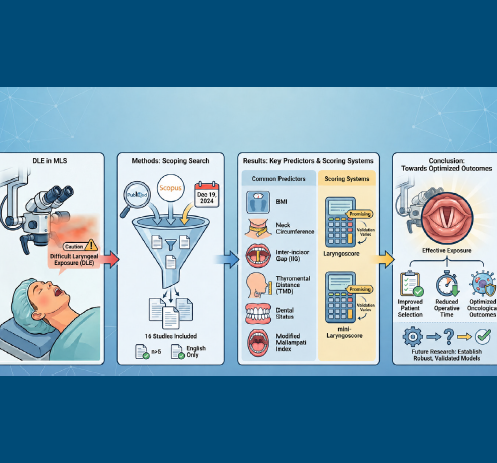
Objective. To conduct a scoping review on difficult laryngeal exposure (DLE) prediction in microlaryngoscopy (MLS). The aim was to identify effective predictive scoring systems or parameters for predicting transoral exposure.
Methods. A comprehensive search was conducted in PubMed and Scopus, with the final search performed on December 19th, 2024. Studies assessing preoperative predictors of DLE in MLS were included if they reported accuracy measures. Studies not in English, with insufficient data, and with sample size < 5 patients were excluded.
Results. Sixteen studies were analysed. Common predictors included body mass index, neck circumference, inter-incisor gap, thyromental distance, dental status, and the modified Mallampati index. Scoring systems like the Laryngoscore and the mini-Laryngoscore showed promise but varied in external validation.
Conclusions. DLE prediction for MLS remains underdeveloped. Validated predictive tools could improve patient selection, reduce operative times, and optimise oncological outcomes by ensuring effective exposure. Further research is needed to establish robust predictive models.
Introduction
Adequate laryngeal exposure is essential for microlaryngoscopy (MLS) to ensure optimal visualisation of the surgical field and safe instrument manipulation.
During suspension laryngoscopy, visualising the glottic structures – especially the anterior commissure – can sometimes be challenging 1. The reported prevalence of difficult laryngeal exposure (DLE) varies widely, ranging from 1.5% to 33.9%. This challenge can lead to prolonged operative times, surgical trauma, diagnostic errors, or incomplete procedures, which is especially problematic in oncological cases 2-7. Numerous strategies have been explored to manage DLE, including applying external laryngeal counterpressure, elevating the patient’s head in the flexion-flexion position, and using laryngoscopes with different shapes or smaller sizes 8-11. Additionally, novel ventilation methods, such as high-frequency jet ventilation and high-flow nasal oxygenation, have improved visualisation of the surgical field 12-15. Despite these methods, achieving adequate laryngeal exposure continues to be challenging in specific cases.
Several potential preoperative predictors of DLE have been studied. The most frequently reported include body mass index (BMI) 2,5,6,16-25, neck circumference (NC) 2,6,7,16,17,22,23,25, upper jaw dental status 18-21,23-25, interincisor gap (IIG) 18-21,23-25, a history of previous head and neck surgery and/or radiotherapy 18-21,23-25, and the Modified Mallampati Index (MMI) 5-7,16,18-26. However, results across studies have been inconsistent. In 2014, Piazza et al. introduced the Laryngoscore, a preoperative tool designed to predict glottic visibility based on 11 clinical factors 18. In 2019, a simplified version, the mini-Laryngoscore, was developed by the same research group, focusing on 3 key predictors: IIG, upper jaw dental status, and thyroid-mental distance (TMD) 21. Validating these scores in diverse patient populations and enhancing them with additional variables are essential to ensure their reliability and applicability. To date, the external validity of the mini-Laryngoscore has been tested only once in a study by Clarysse et al. 23.
This introduction highlights the need for preoperative predictors of DLE which must be objective, reproducible, and easy to obtain. For these reasons, a scoping review was conducted to critically evaluate existing literature on DLE prediction for MLS. The objective was to identify the most effective score for predicting difficult exposure or, if lacking, to determine the optimal parameters to combine for developing a new, reliable predictive score.
Materials and methods
This study was performed according to the Preferred Reporting Items for Systematic reviews and Meta-Analyses extension for Scoping Reviews (PRISMA-ScR) guidelines. This review of previously published studies did not require institutional review board approval, nor informed consent. No review protocol was registered for this study.
This scoping review was conducted according to the PICOS tool: Patients (P), adults undergoing MLS; Intervention (I), preoperative predictive parameters/tool of DLE; Comparator (C), comparison of patients with difficult exposure with those without; Outcomes (O), laryngeal exposure situation; Study design (S), prospective and retrospective case-control studies.
PubMed, Scopus, and Cochrane Library databases were searched for relevant publications. Relevant keywords, phrases, and medical subject headings (MeSH) terms were used according to each database requirement. As an example, the following queries was used for PubMed:
- ((“Laryngeal exposure”[Title/Abstract] OR “Endoscopic exposure”[Title/Abstract] OR “Surgical exposure”[Title/Abstract] OR “Exposure scoring”[Title/Abstract] OR “Visibility scoring”[Title/Abstract] OR “Laryngeal visibility”[Title/Abstract] OR “Operative field exposure”[Title/Abstract] OR “Operative field visualization”[Title/Abstract]) AND (“Transoral surgery”[Title/Abstract] OR “Laryngeal surgery”[Title/Abstract] OR “Microlaryngeal surgery”[Title/Abstract] OR “Laryngoscopy”[Title/Abstract] OR “Endoscopic surgery”[Title/Abstract])) AND (“Outcome measures”[Title/Abstract] OR “Scoring”[Title/Abstract] OR “Assessment”[Title/Abstract] OR “Evaluation”[Title/Abstract])).
- ((measures[Title/Abstract] OR scoring[Title/Abstract] OR assessment[Title/Abstract] OR measurement[Title/Abstract] OR “scoring system”[Title/Abstract] OR scale[Title/Abstract] OR evaluation[Title/Abstract] OR index[Title/Abstract] OR grading[Title/Abstract]) AND (“laryngeal exposure”[Title/Abstract] OR laryngeal[Title/Abstract] OR larynx[Title/Abstract]) AND (exposure[Title/Abstract] OR visualization[Title/Abstract] OR access[Title/Abstract] OR “glottic exposure”[Title/Abstract])) AND (“Transoral Surgery”[MeSH Terms] OR “Endoscopic Surgery”[MeSH Terms] OR “Laryngoscopy”[MeSH Terms] OR “transoral surgery”[Title/Abstract] OR “transoral laryngeal surgery”[Title/Abstract] OR “transoral laser surgery”[Title/Abstract] OR “endoscopic surgery”[Title/Abstract] OR “minimally invasive surgery”[Title/Abstract] OR microlaryngoscopy[Title/Abstract]).
Bibliographies of the selected papers were checked for additional eligible studies. The last research was carried out on December 19th, 2024. Two independent reviewers (CV and AP) conducted the search sequentially evaluating the titles, abstracts, and then full text of the selected papers to minimise selection bias and errors. Systematic data extraction from the included studies was made using a structured data-charting form, independently compiled by one author (CV) to extract the following characteristics: number of patients (total, with and without DLE); predictive parameters and scores for DLE; intraoperative assessment method for DLE; sensitivity, specificity, positive predictive value (PPV), negative predictive value (NPV), and area under curve (AUC) of each parameter; exclusion criteria of each study. Finally, another author checked for accuracy (CZ). Eventual disagreements between reviewers were solved by discussion and consensus between them.
Studies evaluating preoperative predictors of DLE in MLS and reporting diagnostic accuracy measures such as sensitivity, specificity, PPV, NPV, and AUC, were included and critically analysed. Studies were excluded if they (a) were not in English, (b) reported insufficient data or data were not extractable, and (c) included less than 5 patients. No publication date was imposed, but articles had to be already published in a peer-reviewed journal. See Figure 1 for the PRISMA flow diagram.
Results
Numerous studies explored strategies to predict DLE. This review has provided 16 studies, whose characteristics are presented in Table I. Each study identified several predictive parameters and some proposed scores, analysed in Table II.
Preoperative endoscopy
Office-based laryngoscopic grading demonstrated a strong correlation with laryngeal exposure during operative laryngoscopy. Specifically, a grade of 2 or more was highly sensitive and specific in identifying cases of DLE 27.
Objective metrics
Objective metrics have been extensively studied and identified as key predictors of DLE. BMI has shown to play a significant role, with values exceeding 25 kg/m2 consistently associated with a higher risk of DLE 16. NC is another critical parameter. Studies have demonstrated that larger NCs, particularly those over 40 cm, are strongly correlated with increased difficulty in achieving adequate laryngeal exposure 6. This relationship has been consistently observed across various thresholds ranging from 34.2 to 42 cm 7,16,22,26. Table III shows all the different proposed NC cut-off values and their accuracy. Interestingly, one study also highlighted neck length, identifying lengths below 15.3 cm as an additional risk factor for DLE 26. These findings emphasise the impact of obesity on laryngeal visualisation.
Atlanto-occipital (A-O) extension, a measure of neck mobility, has also been implicated in DLE. Limited extension, defined as angles below 19.5°, was shown to significantly increase the likelihood of difficult exposure 7.
TMD is another well-established parameter, with reduced measurements – commonly below 5.5 cm – consistently associated with increased risk 16,21,22,24. Table IV summarises the various proposed TMD cut-off values along with their corresponding accuracy. Other anatomical features – such as prominent or irregular upper jaw dentition, micrognathia, and macroglossia – were frequently observed in patients experiencing DLE 18,19,21,23,25. Patients with a history of neck surgery or radiotherapy were also significantly more likely to encounter DLE 23.
The MMI 28 has been extensively studied for its predictive power 17,20,22,24. It has shown a robust statistical correlation with DLE across multiple studies. Notably, Hekiert et al. identified the Mallampati score as the only significant independent predictor. Interestingly, this correlation held true for both obese and non-obese patients, with obesity providing no additional predictive information when the Mallampati score was already elevated 17.
Multiparametric scoring systems
To enhance the predictive accuracy of DLE, various multiparametric scoring systems have been proposed. Among these, the Laryngoscore has been widely used. With a cut-off score of 6, it demonstrates good overall accuracy 18. However, external validation studies have revealed variability in its performance, suggesting that further research is needed to refine its applicability and establish an optimal threshold 19-21,23,24.
The mini-Laryngoscore, a simplified version of the original system, offers similar predictive accuracy while being easier to use 21. Despite its promise, it also requires further validation to confirm its effectiveness across diverse patient populations 23,25.
More recently, Clarysse et al. developed a scoring system incorporating just 3 parameters – IIG, dental status, and prior treatments – which showed high predictive value 23. Similarly, Teixeira et al. proposed a model that combined NC, IIG and dental status, yielding comparable accuracy 25.
Areas of uncertainty
The IIG has emerged as an important predictor. Reduced gaps, particularly under 4 cm, have been linked to higher rates of DLE 18,21. However, research suggests that a threshold of 5 cm might provide better predictive accuracy. Furthermore, treating IIG as a continuous variable enhanced its predictive value 23. Despite these findings, some studies have reported no significant correlation between IIG and DLE, indicating potential variability in its reliability 19.
Intraoperative assessment method
The most used intraoperative assessment method for DLE relies on visualising the anterior commissure during direct laryngoscopy, with the classification ranging from complete (class 0) to impossible visualisation (class IV) 18,21. In all studies utilising this method, DLE is defined as class III and IV.
Discussion
Numerous studies have explored strategies to predict DLE. The review conducted with the abovementioned queries has identified 16 studies. However, the available literature has several limitations. Firstly, all but one 18 of the studies are single-centre, with most studies having a small sample size that could hinder the evaluation of a relatively rare event as difficult exposure 20,23-26. Another key issue is the exclusion criteria. To better reflect daily practice, studies should ideally avoid restrictive criteria 18,23,26. Excluding patients with previous head and neck surgery and/or radiotherapy introduces a potential bias, excluding a significant portion of patients who may need MLS 2,6,7,16,22. Manjunath and colleagues, for instance, excluded patients with glottic cancer – a major indication for MLS – reducing the study’s reliability in this setting 29. Additionally, other authors excluded patients with lesions obscuring glottic structures; this may represent a confounding factor since the lesion might be itself the indication for transoral surgery 7,20. Finally, unspecified 2 or subjective parameters like the visual analogue scale 17 and the Cormack-Lehane score 6,7,16,22 have been used to assess exposure difficulty intraoperatively, though this may limit reproducibility.
It is also important to note the limited comparability between studies, due to the use of different types of laryngoscopes, varying patient positions, and the lack of a standardised definition of DLE. In some studies 7,16, a modified version of the Cormack and Lehane scale is used, defining DLE as the condition where only the arytenoids are visible or when the entire glottis and arytenoids are hidden. The Cormack and Lehane scale is commonly employed by anaesthesiologists to assess whether the laryngeal view is adequate for endotracheal intubation 30-32. However, in laryngology, even slight differences in laryngeal exposure can significantly impact the surgical outcomes, which could suggest that this scale might not be the most appropriate choice for laryngology studies. Other studies 18,19,25, define DLE based on exposure of the anterior commissure and the size of the laryngoscope required to visualise it.
Instrument availability between different centres may also act as a confounding factor. The Zeitel’s suspension system33 (used to create both the Laryngoscore and the mini-Laryngoscore by Piazza et al. 18,21) allows to get an optimal visualisation of the anterior commissure even when classic table-hold suspension systems fail to achieve it. However, it is not universally used and this may at least partly explain the differences in cut-off of different predictors described by different authors. External validation of these predictive scores should therefore use the same set of laryngoscopes and suspension system.
While Wang et al. 33 provide a valuable quantitative synthesis of predictors for DLE, their study included just independent predictors, excluding from analysis the existing scores such as the Laryngoscore, and does not focus on clinical applicability and practicality in routine settings. In contrast, this scoping review aims to critically evaluate not only individual predictive parameters but also the external validation and clinical usability of multiparametric scoring systems. Moreover, the present review incorporates a broader discussion of real-world limitations – including variability in DLE definitions, surgical instrumentation, and preoperative assessment methods – that are often overlooked. This broader approach supports the need for a clinically oriented, comprehensive framework to guide future tool development and validation.
Preoperative endoscopy
The utility of office-based rigid laryngoscopy, particularly with a 70° endoscope, has been highlighted as a valuable screening tool for predicting DLE. A strong correlation has been demonstrated between laryngoscopic grading in the office setting and intraoperative exposure, with grades based on glottic and anterior commissure (AC) visualisation 29. Grade 1 represents full visualisation of the AC without undue tongue traction, grade 2 indicates AC visualisation only during phonation or with moderate tongue traction, and grade 3 denotes the inability to visualise the glottis despite moderate traction. While this system offers a reliable framework, it has limitations. For instance, the study did not account for malignant lesions. It also did not incorporate flexible laryngoscopy, which is often the primary tool for evaluating laryngeal pathology. Additionally, the potential for interrater variability may introduce subjectivity into assessments, though experienced practitioners can typically mitigate this concern. Some patients also poorly tolerate office-based 70° rigid laryngoscopy, potentially causing false DLEs becoming good exposures under general anaesthesia and myorelaxation in the operating room.
Objective metrics
A reliable predictive tool should be objective, reproducible, and feasible in an outpatient setting. Teixera et al. 25 deemed certain parameters difficult to measure in a reliable way in the outpatient setting, suggesting their exclusion for preoperative predictive models despite their statistical significance:
- the sternum-mental distance (SMD )2,6,7,16,22,25, though statistically significant in Pinar et al.’s study when less than 13.9 cm in full neck extension 6;
- the hyoid-mental distance (HMD) 2,6,16,25,34, though showing significance in Pinar’s correlation analysis, with a threshold less than 6 cm in full neck extension 6;
- the thyroid-mandible angle (TMA) 7,16,34, though significant with a cut-off of > 120° in male and > 130° in female patients 34;
- the sternum-mental angle (SMA) 22, though demonstrating a significant relationship with DLE in multivariate regression analysis when ⩽ 22.5° in full neck extension;
- the degree of maximum neck flexion-extension, even if Piazza et al., Arjun and Dutta, and Nautiyal et al. found it statistically significant 18,20,24;
- radiographic parameters 2.
The following parameters have also been evaluated but did not show a consistency in all the studies: height, weight, angle of neutral-to-extension, trismus, mandibular prognathism, mandibular retrognathism, mandibular tori, vertical incisor-thyroid distance, horizontal incisor-thyroid distance, thyroid-incisor angle, anterior mandible height, and obstructive sleep apnoea syndrome.
Several objective metrics have been explored to predict DLE, with varying degrees of reliability and applicability. BMI consistently emerges as a significant predictor 16,18,20, with a threshold of > 25 kg/m2 achieving moderate sensitivity and specificity 16. The association between increasing BMI and difficult intubation has been well-documented 35, though Brodsky et al. suggested that NC might be a more accurate predictor 36. NC, which reflects upper body fat distribution, has shown a stronger correlation with central adiposity and DLE risk 37. However, studies evaluating NC as a predictor of DLE have yielded inconsistent results. While many authors reported significant associations between NC and DLE 6,7,16,22,25,26, some did not 2,17, and the variability in reported cut-off values – ranging from 34 cm to 42 cm – highlights the challenge of standardising this parameter.
Cervical spine characteristics, such as A-O extension, further complicate laryngeal exposure 7. An A-O extension below 19.5° has been identified as a significant risk factor, underscoring the role of head and neck mobility. Liu et al. noted that parameters measured at full neck extension, including TMD, SMD, and SMA, exhibited higher sensitivity than other predictors 22. However, the continuous nature of A-O extension and the practical challenges of measuring it, such as the need for a goniometer, limit its utility as a rapid assessment tool in clinical settings.
The IIG has proven to be another reliable predictor. While thresholds of < 4 cm are commonly cited 18,21,25, some studies, such as that by Clarysse et al., suggest a higher cut-off of 5 cm provides better predictive accuracy 23. However, findings remain mixed, with some researchers reporting no significant correlation 19. Similarly, TMD has been frequently studied, though its cut-off values vary widely, ranging from 5.5 cm to 7.2 cm 16,21,22,24. Upper jaw dental status also plays a role, as prominent or abnormal dentition can impede laryngeal exposure by limiting mouth opening and posing a risk of dental injury 18,19,21,23,25.
Finally, anatomical abnormalities such as micrognathia and macroglossia have been statistically associated with DLE 18, as has a history of prior neck surgery or radiotherapy 23. The MMI, despite mixed results, is frequently included in risk assessments. While some studies identify MMI as a significant predictor of DLE 17,20,22,24, others do not 5,6,16,18, reflecting the ongoing debate over its reliability.
For MMI, Hsiung et al. 5, Roh and Lee 16, Pinar et al. 6, and Piazza et al. 18 reported that it was not a good predictor of DLE; while Hekiert et al. 17, Arjun and Dutta 20, Liu et al. 22, and Nautiyal et al. 24 identified it as an important risk factor for DLE.
Continuous variables, such as BMI, NC, neck length, A-O extension, IIG, and TMD may complicate the application of a score in clinical practice, even because they require an established cut-off. While there is consensus on a BMI cut-off of > 25 kg/m2, no consensus exists for the other values.
Multiparametric scoring systems
The integration of multiple predictors into scoring systems has the potential to enhance the precision of DLE risk assessments. The Laryngoscore, proposed by Piazza et al., is one of the most validated tools in this regard, showing good overall accuracy across diverse patient populations 18. Despite its strengths, external validation studies have revealed variable sensitivity and specificity, suggesting that local calibration of the score may be necessary 19-21,23,24. Tirelli et al. further validated the Laryngoscore by demonstrating its reproducibility across operators 19, while Arjun and Dutta extended its application to the Indian population 20.
The mini-Laryngoscore, introduced by Incandela et al. 21, offers a simplified alternative while maintaining similar accuracy. However, its limited validation underscores the need for further studies to confirm its reliability 23,25. Both the validation studies underscored the significance of the upper jaw dental status and IIG, while TMD did not exhibit an independent correlation with DLE.
Recently, novel predictive models, such as those by Clarysse et al. 23, Nautiyal et al. 24, and Teixeira et al. 25, have aimed to streamline DLE prediction by focusing on fewer parameters. Although promising, these models require validation to establish their accuracy and generalisability.
The integration of various independent predictors of DLE into a single score holds the potential to improve the precision of diagnosis. Notably, all the variables in the existing scores (except for the Laryngoscore which also includes trismus, mandibular prognathism and degree of neck flexion-extension) are among those found to be significant in our literature review, indicating that they are significant not only individually but also in combination.
Future directions
There is a need for multicentre studies with large sample sizes to further explore the variables (namely, BMI, NC, neck length, IIG, TMD, upper jaw dental status, micrognathia, macroglossia, history of previous open-neck surgery and/or radiotherapy, and MMI), validate existing scores and develop new predictive tools. These studies should have broad participant inclusion criteria, avoid subjective parameters, and ensure consistent use of precisely specified laryngoscope types, patient positioning, and outcome measures. For instance, the intraoperative assessment method for DLE can rely on visualising the anterior commissure during direct laryngoscopy, as suggested by Piazza et al. 18. Additionally, factors such as NC, IIG and TMD have shown potential, but appropriate cut-off values must be defined for each.
The role of laryngoscopy, based on office-based 70° rigid laryngoscopy results 29, should also be explored, despite the potential for interrater variability because it is believed that an experienced clinician can generally make a reliable assessment, and the possible poor compliance of some patients.
Finally, prospective studies are needed to assess the impact of DLE on surgical outcomes and complications.
Conclusions
Predicting difficult laryngeal exposure for MLS remains an evolving area. Even if numerous studies have already attempted to identify reliable preoperative predictors, no single parameter consistently predicts its occurrence. Commonly implicated factors include BMI, NC, IIG, TMD, upper jaw dental status, and the MMI. Although the Laryngoscore and mini-Laryngoscore have shown promising predictive capacity, their external validation has revealed variability. More recently proposed predictive models integrating key parameters (NC, IIG, and dental status) may improve accuracy, but these lack widespread validation as well.
Future research should strive for robust, multicentre, prospective studies that include large patient populations, consistent and objective measurement methods, and standardised definitions of difficult exposure. Validated predictive tools could enhance patient selection, reduce operative times, avert failed procedures, and guide treatment strategies, particularly in oncologic settings where optimal exposure is crucial for achieving safe, complete resections. Ultimately, a reliable, clinically feasible predictive model could improve surgical planning, patient counselling, resource allocation, and overall procedural success.
Conflict of interest statement
The authors declare no conflict of interest.
Funding
This research did not receive any specific grant from funding agencies in the public, commercial, or not-for-profit sectors.
Author contributions
CV: study conception, literature search, data extraction, manuscript drafting; AP: study conception, independent review of the literature search, methodological supervision, substantial manuscript revisions; CZ: literature search, data extraction, contribution to critical revision and editing; GM: scientific supervision, validation of results, critical revision of the manuscript.
History
Received: August 24, 2025
Accepted: December 5, 2025
Figures and tables
Figure 1. PRISMA flow diagram of article screening.
| First author (year) | Study design | Number of participants | Number of DLE patients (%) |
|---|---|---|---|
| Hsiung (2004) 5 | Prospective observational | 56 | 19 (33.9) |
| Roh (2005) 16 | Prospective observational | 73 | 13 (17.8) |
| Hekiert (2007) 17 | Prospective observational | 63 | 31 (49.2) |
| Pinar (2009) 6 | Prospective observational | 93 | 22 (23.7) |
| Piazza (2014) 18 | Prospective observational | 319 | 43 (13.5) |
| Paul (2016) 7 | Prospective observational | 117 | 31 (26.5) |
| Tirelli (2019) 19 | Prospective observational | 136 | 31 (22.8) |
| Arjun (2019) 20 | Prospective observational | 32 | 8(25) |
| Incandela (2019) 21 | Prospective observational | 310 | 45 (14.5) |
| Kharrat (2022) 2 | Prospective observational | 71 | 19 (26.8) |
| Liu (2022) 22 | Prospective observational | 95 | 22 (23.2) |
| Nerurkar (2022) 26 | Prospective observational | 42 | 10 (23.8) |
| Clarysse (2024) 23 | Prospective observational | 103 | 18 (17.5) |
| Manjunath (2024) 29 | Prospective observational | 69 | 9(13) |
| Nautiyal (2024) 24 | Prospective observational | 150 | 27(18) |
| Teixeira (2024) 25 | Prospective observational | 80 | 24(30) |
| Parameter | Sensitivity (%) | Specificity (%) | PPV (%) | NPV (%) | AUC | OR | 95% CI | p value |
|---|---|---|---|---|---|---|---|---|
| Rigid laryngoscopic grading ≥ 2 27 | 93.3 | 100 | - | - | 0.97 | - | - | - |
| BMI (> 25 kg/m2) 16 | 61 | 70 | 30 | 89 | - | - | - | - |
| NC (variable) 7,16,22,26 | 45.5-90 | 38-83.6 | 32-45.5 | 83.6-89 | - | NA | NA | NA |
| Neck length (< 15.3 cm) 26 | 63 | 60 | - | - | - | - | - | - |
| A-O extension (< 19.5°) 7 | 80 | 8.3 | - | - | - | 3.64 | 0.89-14.88 | 0.07 |
| TMD (variable) 16,22 | 61-86.4 | 72.6-73 | 33-48.7 | 89-94.6 | 0.82 | NA | NA | NA |
| History of neck surgery and/or radiotherapy 23 | - | - | - | - | - | 4.23 | 1.16-15.44 | 0.03 |
| MMI 22 | 54.5 | 84.9 | 52.2 | 86.1 | 0.69 | 4.54 | 1.48-13.97 | 0.008 |
| Score | Sensitivity (%) | Specificity (%) | PPV (%) | NPV (%) | AUC | OR | 95% CI | p value |
| LS ≥ 6 18,20,21,23 | 63-87.5 | 75-86 | 40-53.8 | 94-94.7 | 0.73-0.74 | - | - | - |
| LS ≥ 4 19 | 80.6 | 51.4 | 32.9 | 90 | 0.73 | - | - | - |
| Mini-LS 23,25 | - | - | 60 | 76.9 | 0.71-0.73 | - | - | - |
| New Prediction Model by Clarysse 23 | - | - | - | - | 0.84 | - | - | - |
| New Prediction Model by Teixeira 25 | - | - | 76.2 | 86.4 | 0.89 | - | - | - |
| PPV: positive predictive value; NPV: negative predictive value; AUC: area under curve, OR: odds ratio; 95% CI: 95% confidence interval; BMI: body mass index; NC: neck circumference; A-O extension: atlanto-occipital extension; TMD: thyroid-mental distance in neck full extension; MMI: Modified Mallampati Index; LS: Laryngoscore; Mini-LS: mini-Laryngoscore. | ||||||||
| NC cut-off (cm) | OR | 95% CI | p value |
|---|---|---|---|
| > 40 6 | 12.82 | 1.29-127.37 | 0.03 |
| > 39.5 16 | 4.04 | 1.16-14.13 | 0.02 |
| > 34.2 7 | 3.73 | 0.87-16.04 | 0.08 |
| > 42 22 | - | 0.5-0.78 | 0.05 |
| > 39.8 25 | 1.4 | 1.1-1.9 | - |
| NC: neck circumference; OR: odds ratio 95%; CI: 95% confidence interval. | |||
| TMD cut-off (cm) | OR | 95% CI | p value |
|---|---|---|---|
| < 5.5 16 | 4.4 | 1.25-15.4 | 0.02 |
| < 6 21 | 4.59 | 1.11-18.98 | 0.04 |
| ≤ 7.2 22 | 0.07 | 0.01-0.39 | 0.002 |
| TMD: thyroid-mental distance; OR: odds ratio; 95% CI: 95% confidence interval. | |||
References
- Joshi A, Velecharla M, Patel T. Management of difficult laryngeal exposure during suspension microlaryngoscopy. Indian J Otolaryngol. 2019;71:81-85. doi:https://doi.org/10.1007/s12070-018-1481-6
- Kharrat I, Achour I, Trabelsi J. Prediction of difficulty in direct laryngoscopy. Sci Rep. 2022;12. doi:https://doi.org/10.1038/s41598-022-13523-4
- Piazza C, Paderno A, Grazioli P. Laryngeal exposure and margin status in glottic cancer treated by transoral laser microsurgery. Laryngoscope. 2018;128:1146-1151. doi:https://doi.org/10.1002/lary.26861
- Chang C, Chu P. Predictors of local recurrence of glottic cancer in patients after transoral laser microsurgery. J Chin Med Assoc. 2017;80:452-457. doi:https://doi.org/10.1016/j.jcma.2016.12.003
- Hsiung M, Pai L, Wang H. Clinical predictors of difficult laryngeal exposure. Laryngoscope. 2004;114:358-363. doi:https://doi.org/10.1097/00005537-200402000-00033
- Pinar E, Calli C, Oncel S. Preoperative clinical prediction of difficult laryngeal exposure in suspension laryngoscopy. Eur Arch Otorhinolaryngol. 2009;266:699-703. doi:https://doi.org/10.1007/s00405-008-0802-1
- Paul R, Rudraprasad R, Kumar L. Difficult laryngeal exposure in microlaryngoscopy: can it be predicted preoperatively?. Indian J Otolaryngol Head Neck Surg. 2016;68:65-70. doi:https://doi.org/10.1007/s12070-015-0914-2
- Zeitels S, Vaughan C. “External counterpressure” and “internal distention” for optimal laryngoscopic exposure of the anterior glottal commissure. Ann Otol Rhinol Laryngol. 1994;103:669-675. doi:https://doi.org/10.1177/000348949410300902
- Friedrich G, Gugatschka M. Influence of head positioning on the forces occurring during microlaryngoscopy. Eur Arch Otorhinolaryngol. 2009;266:999-1003. doi:https://doi.org/10.1007/s00405-008-0823-9
- Cheng J, Woo P. Rescue microlaryngoscopy: a protocol for utilization of four techniques in overcoming challenging exposures in microlaryngeal surgery. J Voice. 2012;26:590-595. doi:https://doi.org/10.1016/j.jvoice.2011.09.002
- Alharbi A, Chambrin G, Laccourreye O. Optimizing anterior laryngeal exposure during direct suspension laryngoscopy in adults. Eur Ann Otorhinolaryngol Head Neck Dis. 2024;141:37-39. doi:https://doi.org/10.1016/j.anorl.2023.09.007
- Hsu J, Tan M. Anesthesia considerations in laryngeal surgery. Int Anesthesiol Clin. 2017;55:11-32. doi:https://doi.org/10.1097/AIA.0000000000000142
- Benninger M, Walz P, Choi S. Utility of transnasal humidified rapid insufflation ventilatory exchange for microlaryngeal surgery. Laryngoscope. 2021;131:587-591. doi:https://doi.org/10.1002/lary.28915
- Ma B, Kang Z, Huang M. High-flow nasal cannula in nonlaser microlaryngoscopic surgery: a prospective study of 19 cases in a Chinese population. BMC Anesthesiol. 2022;22. doi:https://doi.org/10.1186/s12871-022-01604-8
- Rutt A, Hawkshaw M, Sataloff R. Apneic technique in laryngotracheal surgery. Cureus. 2022;14. doi:https://doi.org/10.7759/cureus.21584
- Roh J, Lee Y. Prediction of difficult laryngeal exposure in patients undergoing microlaryngosurgery. Ann Otol Rhinol Laryngol. 2005;114:614-620. doi:https://doi.org/10.1177/000348940511400808
- Hekiert A, Mick R, Mirza N. Prediction of difficult laryngoscopy: does obesity play a role?. Ann Otol Rhinol Laryngol. 2007;116:799-804. doi:https://doi.org/10.1177/000348940711601103
- Piazza C, Mangili S, Bon F. Preoperative clinical predictors of difficult laryngeal exposure for microlaryngoscopy: the Laryngoscore. Laryngoscope. 2014;124:2561-2567. doi:https://doi.org/10.1002/lary.24730
- Tirelli G, Boscolo Nata F, Gatto A. Predicting laryngeal exposure in microlaryngoscopy: external validation of the Laryngoscore. Laryngoscope. 2019;129:1438-1443. doi:https://doi.org/10.1002/lary.27657
- Arjun A, Dutta A. A study of application of preoperative clinical predictors of difficult laryngeal exposure for microlaryngoscopy: the Laryngoscore in the Indian population. Indian J Otolaryngol Head Neck Surg. 2019;71:480-485. doi:https://doi.org/10.1007/s12070-018-1505-5
- Incandela F, Paderno A, Piazza C. Glottic exposure for transoral laser microsurgery: proposal of a mini-version of the Laryngoscore. Laryngoscope. 2019;129:1617-1622. doi:https://doi.org/10.1002/lary.27718
- Liu Y, Zhang J, Han D. Sternum-mental angle: a new predictor of difficult laryngeal exposure in suspension microsurgery – An observational study. Eur Ann Otorhinolaryngol Head Neck Dis. 2022;139:202-207. doi:https://doi.org/10.1016/j.anorl.2021.04.006
- Clarysse C, Van Lierde K, Dierckx de Casterlé B. Prospective evaluation and validation of the Laryngoscore and the mini-Laryngoscore. Laryngoscope. 2024;134:1807-1812. doi:https://doi.org/10.1002/lary.31161
- Nautiyal S, Kumar Agarwal V, Bist S. Assessment of preoperative predictors for difficult laryngeal exposure in endolaryngeal surgery. Indian J Otolaryngol Head Neck Surg. 2024;76:490-494. doi:https://doi.org/10.1007/s12070-023-04038-0
- Teixeira M, Sousa C, Fernandes V. Bedside preoperative predictors of difficult laryngeal exposure in microlaryngeal surgery. Eur Arch Otorhinolaryngol. 2024;281:2539-2546. doi:https://doi.org/10.1007/s00405-023-08364-5
- Nerurkar N, Hajela A, Sarkar A. A prospective study to correlate difficult intubation with difficult laryngeal exposure for microlaryngeal surgery using various grading scales of difficult intubation. Indian J Otolaryngol Head Neck Surg. 2022;74:427-433. doi:https://doi.org/10.1007/s12070-021-02826-8
- Varghese S, Kumar N, Varghese A. Using office-based zero-degree rigid laryngoscopy to predict glottic exposure in microlaryngoscopy. J Voice. Published online 2024. doi:https://doi.org/10.1016/j.jvoice.2024.08.033
- Mallampati S, Gatt S, Gugino L. A clinical sign to predict difficult tracheal intubation: a prospective study. Can Anaesth Soc J. 1985;32:429-434. doi:https://doi.org/10.1007/BF03011357
- Manjunath M, Sachidananda R, Jyothi Swarup R. Office rigid laryngoscopy as a predictor for glottic exposure in microlaryngoscopy. Indian J Otolaryngol Head Neck Surg. 2024;76:1765-1769. doi:https://doi.org/10.1007/s12070-023-03852-w
- Taboada M, Doldán P, Calvo A. Evaluation of the laryngoscopy view using the modified Cormack-Lehane scale during tracheal intubation in an intensive care unit: a prospective observational study. Rev Esp Anestesiol Reanim. 2019;66:250-258. doi:https://doi.org/10.1016/j.redar.2019.01.005
- Chen W, Tian T, Li X. Use of the thyromental height test for prediction of difficult laryngoscopy: a systematic review and meta-analysis. J Clin Med. 2022;11. doi:https://doi.org/10.3390/jcm11175072
- Srivilaithon W, Muengtaweepongsa S, Sittichanbuncha Y. Predicting difficult intubation in emergency department by intubation assessment score. J Clin Med Res. 2018;10:247-253. doi:https://doi.org/10.14740/jocmr3304w
- Wang M, Li Y, Zhang X. Predictors of difficult laryngeal exposure in suspension laryngoscopy: a systematic review and meta-analysis. Clin Exp Otorhinolaryngol. 2024;17:177-187. doi:https://doi.org/10.21053/ceo.2023.01292
- Voyagis G, Kyriakis K, Dimitriou V. Value of oropharyngeal Mallampati classification in predicting difficult laryngoscopy among obese patients. Eur J Anaesthesiol. 1998;15:330-334. doi:https://doi.org/10.1046/j.1365-2346.1998.00301.x
- Brodsky J, Lemmens H, Brock-Utne J. Morbid obesity and tracheal intubation. Anesth Analg. 2002;94:732-736. doi:https://doi.org/10.1097/00000539-200203000-00047
- Ben-Noun L, Sohar E, Laor A. Neck circumference as a simple screening measure for identifying overweight and obese patients. Obes Res. 2001;9:470-477. doi:https://doi.org/10.1038/oby.2001.61
- Saka M, Türker P, Ercan A. Is neck circumference measurement an indicator for abdominal obesity? A pilot study on Turkish adults. Afr Health Sci. 2014;14:570-575. doi:https://doi.org/10.4314/ahs.v14i3.9
Downloads
License

This work is licensed under a Creative Commons Attribution-NonCommercial-NoDerivatives 4.0 International License.
Copyright
Copyright (c) 2026 Società Italiana di Otorinolaringoiatria e chirurgia cervico facciale
How to Cite
- Abstract viewed - 375 times
- PDF downloaded - 78 times