


Laryngology
Vol. 46: Issue 4 - August 2026
Comprehensive description of clinical features of laryngeal dystonia and dystonic vocal tremor
Authors
Maria Raffaella Marchese
 , Lucia D'Alatri
, Daniela Rodolico
, Jacopo Galli
, Lucia D'Alatri
, Daniela Rodolico
, Jacopo Galli
Summary
Cover Image
Objective. This study aimed to characterise laryngeal dystonia (LD) phenotypes using combined classification criteria and to evaluate treatment outcomes with botulinum neurotoxin type A (BoNT-A).
Methods. The study retrospectively reviewed patient medical records from our clinic over 5 years to identify cases of LD. We classified LD subtypes (adductor, abductor, mixed) and dystonic vocal tremor (DVT) based on updated criteria.
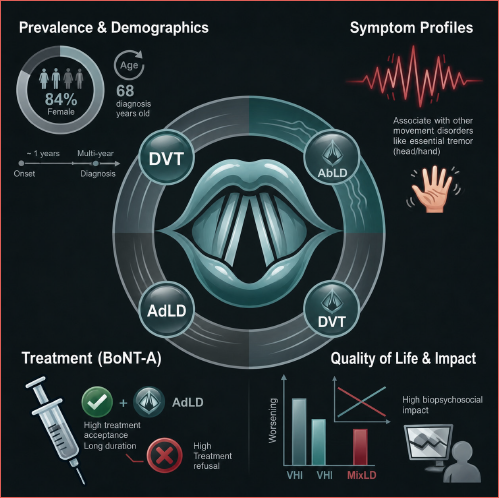
Results. We analysed 75 cases, predominantly adductor LD (60%) and DVT (28%). In all, 84% of patients were females, diagnosed around 68 years of age. The DVT group had late-onset dysphonia that worsened over time and was associated with essential tremor in almost half of cases. Subjects with mixed LD had the greatest increase in Voice Handicap Index (VHI) over time and the longest duration of disease in all cases associated with DVT. Abductor LD cases had the most severe dysphonia (VHI: 73.3). Two-thirds of cases received BoNT-A therapy; most had adductor LD and had received treatment for longer times and had the lowest rate of treatment refusal.
Conclusions. Correct LD classification aids in diagnosis, prognosis and treatment; it should be dynamic and evolve with the patient’s history. However, there is a lack of data in the literature on certain aspects of LD, emphasising the need for further research to improve clinical practice.
Introduction
Dystonia, a hyperkinetic movement disorder, manifests as sustained or intermittent muscle contractions leading to abnormal movements or postures 1. Despite its distinct clinical features, dystonia presents in various forms, making it challenging to diagnose accurately. Current classification of dystonia syndromes relies on clinical characteristics such as age of onset, body distribution, disease progression, and coexistence of other movement disorders, aiding in diagnostic, prognostic, and management decisions 1. Laryngeal dystonia (LD), a sporadic and action-specific form, typically emerges in early or late adulthood, affecting approximately 3.5-7 in 100,000 individuals 2. LD is characterised by task-specific impairment of speech without affecting innate vocal behaviours like laughing or yawning. Despite its significance, there are currently no standardised diagnostic guidelines or comprehensive classifications for LD subtypes. Recently, an updated classification proposed by Simonyan et al. 3 distinguishes LD types based on muscle group involvement and task specificity. However, the literature lacks emphasis on crucial neurological criteria like disease progression and association with other movement disorders, which are useful for prognosis and aetiological understanding. Additionally, in a significant percentage of LD cases, the occurrence of other dystonic foci or neurological disorders may not coincide with disease onset 4. LD primarily presents as severe dysphonia, significantly impacting patients’ biopsychosocial well-being. This warrants collaboration between ENTs/phoniatricians and neurologists throughout the diagnostic, treatment, and follow-up phases, considering the evolving clinical history and advancements in dystonia research. Long-term treatment with botulinum neurotoxin type A (BoNT-A), which represents the current gold standard for the management of LD, provides ENTs/phoniatricians with the opportunity to evaluate the sustained therapeutic efficacy of repeated injections while simultaneously observing the longitudinal clinical course of the disease.
Despite recent advancements in classification criteria of dystonia by Di Biase et al. 5 and tools like the Spasmodic Dysphonia Attributes Inventory (SDAI) by Ludlow et al. 6, as well as terminology updates by Simonyan et al. 5, there is a gap in systematically applying these criteria to characterise the clinical phenotypes of LD. Therefore, our study aims to fill this gap by comprehensively analysing the clinical features of LD using a combination of classification criteria, benefiting from close collaboration with neurologists and long-term patient monitoring. We also assess clinical phenotypic descriptors and data related to BoNT-A treatment to provide a holistic understanding of LD.
Materials and methods
The study was conducted by retrospective patients’ charts review and electronic medical record documentation containing the phrase “laryngeal dystonia” or “adductor spasmodic dysphonia” or “abductor spasmodic dysphonia” or “mixed spasmodic dysphonia” or “mixed laryngeal dystonia” or “respiratory dystonia” or “dystonic tremor” obtained from cases assessed at our clinic over a 5-year period (January 2018 - December 2022). Age 18 years or older, Italian speaking language, no known cause for the voice disorder, no health issue preventing videolaryngoscopy, no laryngeal structural disease, no surgery for LD were the inclusion/exclusion criteria.
The participants who satisfied the criteria were selected for manual examination and electronic extraction of medical record data. Specifically, in order to classify the dystonic disorders basing on the most recent criteria and updated terminology, we extracted endoscopic video and audio recording during speech, phonation and whispering, and auditory perceptual features. After data extraction, the clinical features related to LD and vocal tremor meeting the Simonyan 3, Ludlow 6, Torrecillas 7 and Merati 8 criteria were used to distinguish adductor (AdLD), abductor (AbLD), mixed dystonia (MixLD) and dystonic vocal tremor (DVT) (Fig. 1). Moreover, taking into account the criteria for dystonia classification provided by Albanese et al. 1 and Di Biase et al. 5, we extracted further data that are listed in the Table I in order to analyse additional clinical features of each form of LD.
Only classification categories with ≥ 4 individuals were included in the analyses. Those with conflicting or inadequate clinical descriptors were marked as “insufficient information to classify”.
Statistical analysis
We used descriptive statistics to quantitatively summarise the features from our data set and by laryngeal dystonia classification.
Results
A total of 107 subjects met inclusion criteria and 96/107 (89.7%) patients had sufficient documentation of clinical features to classify them as having LD. All 96 (100%) patients completed videolaryngostroboscopy. Of these, 3/96 (3.1%) cases assigned to the respiratory LD category were excluded because less than 4. Of 96 cases, none suffered from singer’s dystonia or isolated dystonia of the cricothyroid muscle. Finally, 75/93 (80.6%) patients were included in the analysis. Forty-five of 75 (60%) were classified as AdLD, 5/75 (6.7%) as AbLD, 4/75 (5.3%) as MixLD and 21/75 (28%) as DVT.
Demographic and clinical features. The demographic and clinical features are summarised in Tables I and II.
Sex. Regardless of the type of LD, most cases overall were females (84%) and ≥ 80% of patients were females in all groups except for the AbdLD group (60%).
Age. Mean age at the first diagnosis was 68.3 years overall. A similar result was observed in the AdLD group (mean, 67.2 years). The oldest groups were MixLD and DVT with a mean age of 73.3 and 72.8 years, respectively. On the other hand, the youngest group was affected by AbdLD (mean, 54.2 years). Based on the history reported by the patient, the average age at LD onset was 60.8 years. Patients diagnosed with AbdLD showed an earlier mean age of onset (47.6 years). In contrast, the DVT group revealed a later average onset (mean, 65.4 years). The remaining groups were similar to the overall mean age of onset.
Duration of symptoms. The mean duration of LD symptoms (the time from onset of LD and the first visit) was 95.7 months. Patients with the longest history of disease were affected by MixLD (mean, 143 months). Those with AbdLD showed the shortest mean duration of symptoms (mean, 79.5 months). The other types of LD had a duration of disease similar to the overall group (Tab. II).
Family history. A family history of movement disorders (MD) was reported across all LD subtypes except AbdLD. Overall, 26.7% of patients with LD had a positive family history of MD, with the highest prevalence observed in patients with MixLD (50%).
Triggered by stress. Almost one-third of cases affected by LD attributed onset of symptoms following stress (27%). A similar prevalence was observed in all LD groups except for MixLD where no patient reported stress as triggering factor of the disease.
Associated psychiatric illness. At the time of the initial evaluation approximately 20% of subjects with LD were on anti-anxiety therapy. No patients in the AbdLD or MixLD groups reported taking psychotropic drugs.
The prevalence of previous speech therapy or BoNT injection are shown in Table II. Biopsychosocial impact of voice problems was assessed with the Voice Handicap Index (VHI) score. Based on the grading of the VHI score by Grassel et al. 13, the patients affected by LD reflected on average a grade 3 of dysphonia that corresponds to definitely noticeable, most severe dysphonia (mean, 57.9). The VHI mean scores of AdLD, AbdLD and DVT were aligned to the overall group (57.4, 56.2, and 53.6 respectively). Patients with MixLD had the most severe dysphonia corresponding to grade 3 (mean, 73.3), the greatest impact of dysphonia on self-perceptions of laryngeal discomfort and voice output characteristics (physical domain), and on affective responses to the voice disorder (emotional subscale). The disease course of LD was different for each subtype of disease. In this regard we observed a slight variation in VHI score in AdLD and a worsening of dysphonia severity in MixLD and DVT.
Auditory-perceptual was assessed with the Unified Spasmodic Dysphonia Rating Scale (USDRS). On average the severity of perceptual symptoms observed in speech of patients with LD was judged as mild-to-moderate regardless of the type of LD. The most severe perceptual dysphonia was observed in the AbdLD.
The overall mean score of OMNI vocal effort scale was about 6 suggesting that the use of voice was usually “somewhat hard”. The amount of the referred effort, strain, discomfort and/or fatigue was similar in all types of LD except for AbdLD where the mean score suggested “hard”/”extremely hard” patient-reported perception of phonatory effort.
Dysphagia. Patients affected by LD referred abnormal swallowing (mean DHI score, 12) that was greater (> 20) in the AbdLD and MixLD groups and lower in the AdLD group.
Associated dystonic vocal tremor. The prevalence of associated dystonic vocal tremor was observed in half of cases of LD (27/54, 50%). A similar percentage was obtained in the AdLD group (23/45 or 51%). Interestingly, all patients with MixLD complained of dystonic vocal tremor.
Other body parts affected by dystonia. Three of 75 (4%) patients had other dystonic foci. In all cases the body parts affected were cervical and/or cranic.
Combined dystonia. Eleven of 75 (15%) subjects affected by LD showed combined dystonia. Specifically, almost half of patients with DVT suffered from head or hand essential tremor and one case of the AdLD group suffered from hand essential tremor.
Botulinum neurotoxin A therapy. BoNT-A therapy was suggested to all patients at the first visit. An overall average treatment refusal rate of 37% was found. More than half patients affected by AbdLD and DVT refused BoNT-A injections. The AdLD group showed the lowest refusal rate (22%).
Overall, two-thirds of cases (63%) underwent BoNT-A injection. The highest percentage of treated patients was observed in the AdLD group (78%) and the lowest in the DVT group. Nevertheless, about 20% of all LD cases dropped out of the therapy and most were in AdLD group (20%). Specifically, 3 patients with LD (3/47 or 6.4%), all in the AdLD group, underwent only one BoNT-A injection. The mean duration of treatment in patients who dropped out of therapy was 21 months and the shortest was observed in the DVT group (4.2 months).
Over the study period we performed 331 BoNT-A injections most of which were in the AdLD group (232/331 or 70%). Cases affected by MixLD underwent the highest number of injections (n = 15.5) per patient, followed by the AdLD group (mean, 9.1). Other details regarding the number of treatments were showed in Table III.
The mean inter-injection interval was 3 months (range, 2 weeks – 6 months). LD patients underwent toxin therapy for an average of 36.2 months. The shortest period was observed in the DVT group (10.2 months). The patients who underwent toxin injection for the longest time were in the AdLD group (139 months).
The effects of BoNT-A therapy on the quality of life related to dysphonia (VHI gain) for each type of LD are presented in Table III.
Discussion
Our study systematically evaluated the clinical features of LD using criteria established by Simonyan et al. 1, Torrecillas et al. 9, Ludlow et al. 8, Albanese et al. 1, and Di Biase et al. 5. The primary aim was to enhance the classification of LD, aiding clinicians in its assessment and treatment, and to describe its phenomenological spectrum. Consistent with the existing literature, our findings indicate that LD predominantly affects women (84%) 3, with a similar female predominance across all LD types, except in AbdLD, where the females prevalence was 60%, likely due to a smaller sample size. LD is typically seen in young adults between their fourth and fifth decades, as noted by Blitzer et al. 10 and Guiry et al. 11, aligning with our data for AdLD and AbdLD. In contrast, DVT tends to develop later, around the fifth and sixth decades, in line with the observations of Torrecillas et al. 7 LD is a complex disorder that is often underdiagnosed or misdiagnosed, necessitating a multidisciplinary clinical approach for accurate diagnosis. Diagnostic challenges include symptom variability, conditions mimicking LD, and limited clinician expertise, which lead to significant diagnostic delays in adult-onset dystonia 12. Our study found an average of 7 years between symptom onset and confirmed diagnosis. Creighton et al. 13 specifically investigated spasmodic dysphonia, reporting an average diagnostic delay of 4.4 years, while Simonyan et al. 5 noted a delay of over 5 years. Such delays cause substantial social and professional hardship for patients and inefficient use of healthcare resources. Both Creighton et al. 13 and Simonyan et al. 3 found that patients typically consult nearly 4 physicians before diagnosis, often resulting in unnecessary and potentially harmful medication prescriptions. Improved clinician education on LD symptoms, especially targeting neurologists, otolaryngologists, and primary care providers, is crucial to ensure timely diagnosis. Blitzer et al. 14 studied a sample of patients with focal LD, reporting an average disease duration of 13.8 years, whereas our study found an average duration of 8 years, comparable to Esposito et al. 4 at 10 years. LD is recognised as a lifelong condition 15, and in our study the average disease duration closely matched the time-to-diagnosis, suggesting that the first visit often coincided with diagnosis. This could be due to most patients being from the same city as our hospital, benefiting from easier access to experienced phoniatricians and neurologists. Disease duration is clinically significant for evaluating symptom progression and disease course over time. External risk factors, such as family history, anxiety, depression, stress, professional voice use, ethnicity, and gender, may interact with genetic factors to increase the risk of developing LD 16. Our cohort showed a notable prevalence of positive family history of MD across all LD types, except AbdLD, with approximately one-third of cases reporting family history. MixLD cases had the highest incidence (50%).
Anxiety comorbidity in LD patients varies widely in literature (7% to 62%), with our study finding around 20% of subjects with a history of anxiety, consistent with White et al. 17. This rate is similar to other benign voice disorders, but higher than the general population. Clinicians should be aware of increased anxiety in patients with chronic voice disorders, particularly young females 17,18. Nearly one-third of our LD cases attributed symptom onset to stress, aligning with the understanding that psychological stress can affect dystonia in several ways 19. A small proportion of patients had prior BoNT-A therapy or speech therapy at their first visit.
Owing to its non-invasive nature and widespread accessibility, speech therapy is frequently among the first line of prescribed treatments. Dejonkere et al. 20 demonstrated the VHI’s suitability for assessing voice-related quality of life in dysphonia caused by LD. Our sample had an average biopsychological impact score of around 58 on the VHI, corresponding to severe dysphonia, particularly in MixLD cases, although the latter group’s small size limits the conclusiveness of this result. Dysphonia primarily affected the physical domain across LD types, indicating significant self-perceived laryngeal discomfort and voice effort. Our OMNI-VES scores supported this severity, especially in the AbdLD group. However, further studies in larger cohorts are needed.
Dysphagia was also notably reported, as assessed using the DHI questionnaire. Our findings suggest that subjects with LD may experience atypical swallowing functions, varying in severity according to LD type. Perceptual symptom severity in connected speech was rated as mild to moderate, with the most severe dysphonia in AbdLD cases. This discrepancy between self-reported and perceived severity highlights different dimensions of assessment 21. Understanding disease progression is crucial for diagnosis, treatment, and prognosis in dystonia 1. While idiopathic cervical dystonia is now considered non-progressive 19, research on LD progression is sparse. Esposito et al. 6 studied the spread of dystonia but not symptom progression in LD. Our study measured progression via changes in total VHI scores over at least 2 years, finding no change in AdLD but worsening in MixLD and DVT. This may suggest stable treatment approaches for AdLD and intensified ones for MixLD and DVT. Dystonic tremor, reported in up to one-third of LD cases 14, was present in half of our patient with LD, similar to cervical dystonia 22. “Combined” LD, occurring with other movement disorders, was observed in 15% of our cohort, often with essential tremor, reflecting the need for comprehensive clinical management.
BoNT-A remains the first-choice treatment for LD, providing temporary but safe symptom relief 23,24. In our study, the average duration of treatment was 3 years, with dropout rates around 20%, comparable to cervical dystonia 25. The roughly 40% BoNT-A treatment refusal rate, particularly high in the DVT group, underscores the need for improved patient counselling and management strategies. The complex diagnosis and clinical management of LD requires considering established classification criteria and clinical features. Accurate assessment and re-evaluation, informed by evolving clinical history and research, are essential. While our study highlights preliminary clinical differences among LD subtypes, further research in larger cohorts and multicentre studies is needed to confirm these findings and enhance our understanding of the clinical spectrum of LD.
Conflict of interest statement
The authors declare no conflict of interest.
Funding
This research did not receive any specific grant from funding agencies in the public, commercial, or not-for-profit sectors.
Author contributions
MRM: contributed to the study conception and design; MRM, RD: material preparation, analysis and data collection; MRM, LD’A, JG: write the first draft of the manuscript. All authors read and approved the final manuscript.
Ethical consideration
This study was approved by the coordinating center Ethics committee (Agostino Gemelli University Hospital Foundation IRCCS) (Protocol n.0010621/24).
The research was conducted ethically, with all study procedures being performed in accordance with the requirements of the World Medical Association’s Declaration of Helsinki.
Written informed consent was obtained from each participant/patient for study participation and data publication.
History
Received: July 15, 2024
Accepted: April 22, 2026
Figures and tables
Figure 1. Comprehensive criteria for the classification of adductor (AdLD), abductor (AbdLD), mixed laryngeal dystonia (MixLD) and dystonic vocal tremor (DVT) based on Ludlow et al., 2018 6, Simonyan et al., 2021 3, Torrecillas et al., 2021 7, Merati et al., 2005 8, Albanese et al.1 and Di Biase et al.5 classifications. *Features reported in Consensus-Based attributes for identifying patients with spasmodic dysphonia and other voice disorders (Ludlow et al., 2018) 6; **Features reported in Laryngeal dystonia - multidisciplinary update on terminology, pathophysiology, and research priorities (Simonyan et al., 2021) 3; §Features reported in Classification of vocal tremor using updated consensus-based tremor classification criteria (Torrecillas et al., 2021) 7 and Common movement disorders affecting the larynx: a report from the neurolaryngology committee of the AAO-HNS (Merati et al., 2005) 8.
| Demographics (age, sex) | Age: Mean age at first diagnosis (years): date of first documented clinic visit minus bithdate Mean age of symptom onset (years): age at first diagnosis minus referred duration of symptoms |
| First visit | The first appointment date for dysphonia |
| Mean duration of disease (months) | Number of months between the first documented clinic visit and the referred symptoms onset |
| Family history for movement disorder | Documented history of movement disorder for family members |
| Associated anxiety or depression | The patient reported taking or having taken in the past drugs for anxiety or depression |
| Triggered by stress | The patient reported at the first visit that the onset of symptoms coincides with a period of stress |
| Previous speech therapy | Yes/no |
| Previous BoNT therapy | Yes/no |
| VHI mean score at the first visit | We used the Italian version of Voice Handicap Index (VHI) to evaluate patient’s subjective perception of the impact of the dysphonia on the quality of life. It is a questionnaire composed of 30 items equally divided between functional, physical and emotional domains, which analyses the biopsychosocial impact of voice problems. Each question has 5 quantifiable answers (0-4); the final total score (0-120) defines the degree of subjective perception of the voice disorder (Schindler et al., 2010). Basing on the grading of VHI proposed by Grassel et al. (2008), the VHI values of 0-11 are classified as grade 0 suffering (almost certainly not noticeable), while values of 12-28 reflect grade 1 (more likely unnoticeable than conspicuous) suffering; values of 29-56 reflect grade 2 suffering (more probably noticeable than not), and values of 57-120 suggest a classification of certainly noticeable and are graded as grade 3 suffering |
| Voice quality course – disease course | Difference between the VHI score at the first visit and that obtained at the last visit (≥ 1 year later and almost 3 months post-BoNT-A injection) |
| The OMNI-VES at the first visit | Omni Vocal Effort Scale (OMNI-VES) is a validated tool for rating self-perceived voice-related exertion in people with AdLD. The OMNI-VES is a pictorial description of the scale to accompany the 0 to 10 equal intervals of gradual increase in vocal effort (min. 0 - max 10) 9 |
| DHI mean score at the first visit | The Dysphagia Handicap Index (DHI) is a valid Health-Related Quality of Life (HRQOL) questionnaire for patients with oropharyngeal dysphagia (OD) of heterogeneous aetiologies (score min. 0 - max 100) 10. Basing on the normative values reported in the review by Sobol et al. 11, the DHI score for individuals without a history of dysphagia or associated conditions was 2.4 (confidence interval 0.5-4.4). Therefore, we considered abnormal a DHI score greater than 2.5 |
| USDRS at the first visit | The Unified Spasmodic Dysphonia Rating Scale (USDRS) is a standard measure that considers the perceptual symptoms observed in connected speech and definitions of those symptoms, and rates them on a 7-point scale of severity (score min. 7 - max 98) 12 |
| Associated dystonic vocal tremor | LD (except dystonic vocal tremor) associated with dystonic vocal tremor |
| Other body parts affected by dystonia | Presence of other body parts treated with botulinum neurotoxin. Dystonia can be classified as focal (one body part is affected), segmental (≥ 2 contiguous body parts are affected), multifocal (≥ 2 non-contiguous body parts are affected), hemidystonia (ipsilateral arm and leg are involved), generalised (≥ 3 body parts are affected, including the trunk and ≥ 2 other sites) 1 |
| Combined dystonia | The LD is combined when there is a movement disorder (i.e., myoclonus, Parkinsonism, essential tremor etc.) in other body sites 5 documented in the history by neurological assessment |
| LD: laryngeal dystonia; BoNT: botulinum neurotoxin. | |
| Clinical characteristics | Laryngeal dystonia (LD) classification | ||||
|---|---|---|---|---|---|
| Adductor LD | Abductor LD | Mixed LD | Dystonic vocal tremor | Total | |
| N = 45 | N = 5 | N = 4 | N = 21 | N = 75 | |
| Sex | |||||
| Female | 36/45 (80%) | 3/5 (60%) | 4/4 (100%) | 20/21 (95.2%) | 63/75 (84%) |
| Male | 9/45 (20%) | 2/5 (40%) | 0/4 (0%) | 1/21 (4.8%) | 12/75 (16%) |
| Mean age of symptom onset (years) | 59.5 | 47.6 | 61.4 | 65.3 | 60.7 |
| Mean age at first diagnosis (years) | 67.2 (SD ± 14.3) | 54.2 | 73.3 | 72.8 | 68.2 |
| Mean duration of disease (months - years) | 93 m - 7.7 y | 79.5 m - 6.6 y | 143 m - 11.9 y | 89.7 m - 7.4 y | 95.7 m - 7.9 y |
| Family history for movement disorder | 11/45 (24.4%) | 0/5 (0%) | 2/4 (50%) | 7/2 (33.3%) | 20/75 (26.7%) |
| Associated psychiatric illness | 8/45 (17.8%) | 0/5 (0%) | 0/4 (0%) | 4/2 (19%) | 12/75 (16%) |
| Triggered by stress | 13/45 (29%) | 1/5 (20%) | 0/4 (0%) | 6/2 (29%) | 20/75 (27%) |
| Previous speech therapy | 11/45 (24.4%) | 1/5 (20%) | 1/4 (25%) | 3/2 (14.3%) | 16/75 (21.3%) |
| Previous BoNT-A therapy | 7/45 (15.5%) | 1/5 (20%) | 0/4 (0%) | 0/2 (0%) | 10/75 (13.3%) |
| VHI mean score at the first visit | |||||
| Mean total score (min. 0 - max 120) | 57.4 | 56.2 | 73.3 | 53.6 | 57.9 |
| Functional domain (score min. 0 - max 40) | 17.8 | 18.6 | 24.3 | 17.7 | 17.8 |
| Emotional domain (score min. 0 - max 40) | 17.6 | 16 | 19.6 | 17.3 | 16.9 |
| Physical domain (score min. 0 - max 40) | 21.8 | 21.6 | 30 | 18.6 | 20.9 |
| Disease course - Difference between the VHI score at the first visit and the one obtained at the last visit (≥ 2 years later) *** | 0.7 | - | -26 | -23 | |
| Omni Vocal Effort Scale at the first visit | 6.4 | 8.6 | 7.3 | 6.2 | 6 |
| Unified Spasmodic Dysphonia Rating Scale (USDRS) at the first visit | 32 | 37.5 | 30.7 | 32.4 | 32.9 |
| Associated dystonic vocal tremor | 23/45 (51%) | 0/5 (0%) | 4/4 (100%) | - | 27/54* (50%) |
| DHI mean score at the first visit | 8.2 | 20.6 | 21.3 | 16.4 | 12 |
| Other body parts affected by dystonia | 1/45 (2.2%) (cervical dystonia) | 1/5 (20%) (cranic and cervical dystonia) | 0/4 (0%) | 1/21 (4.8%) (cranic dystonia) | 3/75 (4%) |
| Combined dystonia | 1/45 (2.2%) (hands essential tremor) | 0/5 (0%) | 0/4 (0%) | 10/21 (48%) (4/10 head essential tremor and 6/10 hand essential tremor) | 11/75 (15%) |
| VHI: voice handicap index; DHI: dysphagia handicap index; BoNT: botulinum neurotoxin. *All cases (75 patients) minus the ones affected by dystonic tremor (21 cases) = 54 cases. | |||||
| Type of laryngeal dystonia (LD) | |||||
|---|---|---|---|---|---|
| AdLD N = 45 | AbdLD N = 5 | MixLD N = 4 | Dystonic Vocal Tremor N = 21 | Total LD N = 75 | |
| No. of patients who refused therapy | 10/45 (22%) | 3/5 (60%) | 2/4 (50%) | 13/21 (62%) | 28/75 (37%) |
| Cases treated with BoNT-A | 35/45 (78%) | 2/5 (40%) | 2/4 (50%) | 8/21 (38%) | 47/75 (63%) |
| No. of patients who dropped out of BoNT therapy* | 7/35 (20%) | 1/2 (50%) | 0/2 (0%) | 2/8 (25%) | 10/47 (21.2%) |
| No. of patients who underwent only one treatment | 3/35 (8.5%) | 0/2 (0%) | 0/2 (0%) | 0/8 (0%) | 3/47 (6.4%) |
| Mean duration of treatment period in patients who dropped out of therapy (months) | 25.3 | 13 | - | 4.2 | 20.7 |
| Min. duration of therapy before interruption (months) | 1 | 2 | - | 4 | 1 |
| Max duration of therapy before interruption (months) | 39 | 13 | - | 8 | 39 |
| Overall number of injections | 232 | 10 | 30 | 44 | 331 |
| Mean number of treatments for each patient | 9.1 | 5 | 15.5 | 8 | 7.7 |
| Min. number of injections for each patient | 3 | 3 | 11 | 2 | 1 |
| Max number of injections for each patient | 43 | 7 | 20 | 21 | 44 |
| Mean duration of the treatment period (months) | 23.5 | 26.5 | 30 | 10.2 | 36.2 |
| Min. duration of therapy | 3 | 10 | 3 | 3 | 3 |
| Max duration of therapy | 139 | 40 | 35 | 118 | 139 |
| Mean VHI gain** one month after BoNT injection | 9.2 | 8.6 | 4.3 | 7.8 | 8.7 |
| Min. | -11.3 | -19 | -15 | -28 | |
| Max | 18.9 | 13 | 4 | 27 | |
| *Patients who, at the time of the present study, had not undergone treatment for one year or more; **Difference between the mean VHI score one month after therapy and before the BoNT-A injection. | |||||
References
- Albanese A, Bhatia K, Bressman S. Phenomenology and classification of dystonia: a consensus update. Mov Disord. 2013;28:863-873. doi:https://doi.org/10.1002/mds.25475
- Blitzer A. Spasmodic dysphonia and botulinum toxin: experience from the largest treatment series. Eur J Neurol. 2010;17:28-30. doi:https://doi.org/10.1111/j.1468-1331.2010.03047
- Simonyan K, Barkmeier-Kraemer J, Blitzer A. Laryngeal dystonia: multidisciplinary update on terminology, pathophysiology, and research priorities. Neurology. 2021;96:989-1001. doi:https://doi.org/10.1212/WNL.0000000000011922
- Esposito M, Fabbrini G, Ferrazzano G. Spread of dystonia in patients with idiopathic adult-onset laryngeal dystonia. Eur J Neurol. 2018;25:1341-1344. doi:https://doi.org/10.1111/ene.13731
- Di Biase L, Di Santo A, Caminiti M. Classification of dystonia. Life (Basel). 2022;12. doi:https://doi.org/10.3390/life12020206
- Ludlow C, Domangue R, Sharma D. Consensus-based attributes for identifying patients with spasmodic dysphonia and other voice disorders. JAMA Otolaryngol Head Neck Surg. 2018;144:657-665. doi:https://doi.org/10.1001/jamaoto.2018.0644
- Torrecillas V, Dwenger K, Barkmeier-Kraemer J. Classification of vocal tremor using updated consensus-based tremor classification criteria. Laryngoscope Investig Otolaryngol. 2021;6:261-276. doi:https://doi.org/10.1002/lio2.544
- Merati A, Heman-Ackah Y, Abaza M. Common movement disorders affecting the larynx: a report from the neurolaryngology committee of the AAO-HNS. Otolaryngol Head Neck Surg. 2005;133:654-665. doi:https://doi.org/10.1016/j.otohns.2005.05.003
- Shoffel-Havakuk H, Marks K, Morton M. Validation of the OMNI vocal effort scale in the treatment of adductor spasmodic dysphonia. Laryngoscope. 2019;129:448-453. doi:https://doi.org/10.1002/lary.27430
- Ginocchio D, Ninfa A, Pizzorni N. Cross-cultural adaptation and validation of the italian version of the Dysphagia Handicap Index (I-DHI). Dysphagia. 2022;37:1120-1136. doi:https://doi.org/10.1007/s00455-021-10369-2
- Sobol M, Kober A, Sielska-Badurek E. The Dysphagia Handicap Index (DHI) – normative values. systematic review and meta-analysis. Dysphagia. 2021;36:1005-1009. doi:https://doi.org/10.1007/s00455-020-10231-x
- Stewart C, Allen E, Tureen P. Adductor spasmodic dysphonia: standard evaluation of symptoms and severity. J Voice. 1997;11:95-103. doi:https://doi.org/10.1016/s0892-1997(97)80029-x
- Grässel E, Hoppe U, Rosanowski F. Graduierung des Voice-Handicap-Index [Grading of the Voice Handicap Index]. HNO. 2008;56:1221-1228. doi:https://doi.org/10.1007/s00106-007-1594-9
- Blitzer A, Brin M, Simonyan K. Phenomenology, genetics, and CNS network abnormalities in laryngeal dystonia: a 30-year experience. Laryngoscope. 2018;128:S1-S9. doi:https://doi.org/10.1002/lary.27003
- Guiry S, Worthley A, Simonyan K. A separation of innate and learned vocal behaviors defines the symptomatology of spasmodic dysphonia. Laryngoscope. 2019;129:1627-1633. doi:https://doi.org/10.1002/lary.27617
- Macerollo A, Superbo M, Gigante A. Diagnostic delay in adult-onset dystonia: data from an Italian movement disorder center. J Clin Neurosci. 2015;22:608-610. doi:https://doi.org/10.1016/j.jocn.2014.09.014
- Creighton F, Hapner E, Klein A. Diagnostic delays in spasmodic dysphonia: a call for clinician education. J Voice. 2015;29:592-594. doi:https://doi.org/10.1016/j.jvoice.2013.10.022
- Blitzer A, Brin M, Stewart C. Botulinum toxin management of spasmodic dysphonia (laryngeal dystonia): a 12-year experience in more than 900 patients. Laryngoscope. 1998;108:1435-1441. doi:https://doi.org/10.1097/00005537-199810000-00003
- Snaith A, Wade D. Dystonia. BMJ Clin Evid. 2014;2014.
- de Lima Xavier L, Simonyan K. The extrinsic risk and its association with neural alterations in spasmodic dysphonia. Parkinsonism Relat Disord. 2019;65:117-123. doi:https://doi.org/10.1016/j.parkreldis.2019.05.034
- White L, Hapner E, Klein A. Coprevalence of anxiety and depression with spasmodic dysphonia: a case-control study. J Voice. 2012;26:667.e1-667.e6676. doi:https://doi.org/10.1016/j.jvoice.2011.08.011
- Hu A, Hillel A, Zhao W. Anxiety and depression in spasmodic dysphonia patients. World J Otorhinolaryngol Head Neck Surg. 2018;4:110-116. doi:https://doi.org/10.1016/j.wjorl.2018.04.004
- Dressler D, Kopp B, Pan L. Excessive psychological stress preceding the onset of idiopathic cervical dystonia. J Neural Transm (Vienna). 2024;131:53-57. doi:https://doi.org/10.1007/s00702-023-02694-7
- Dejonckere P, Neumann K, Moerman M. Tridimensional assessment of adductor spasmodic dysphonia pre- and post-treatment with Botulinum toxin. Eur Arch Otorhinolaryngol. 2012;269:1195-1203. doi:https://doi.org/10.1007/s00405-011-1890-6
- Speyer R, Wieneke G, Dejonckere P. Documentation of progress in voice therapy: perceptual, acoustic, and laryngostroboscopic findings pretherapy and posttherapy. J Voice. 2004;18:325-340. doi:https://doi.org/10.1016/j.jvoice.2003.12.007
- Shaikh A, Beylergil S, Scorr L. Dystonia and tremor: a cross-sectional study of the dystonia coalition cohort. Neurology. 2021;96:E563-E574. doi:https://doi.org/10.1212/WNL.0000000000011049
- Birkent H, Maronian N, Waugh P. Dosage changes in patients with long-term botulinum toxin use for laryngeal dystonia. Otolaryngol Head Neck Surg. 2009;140:43-47. doi:https://doi.org/10.1016/j.otohns.2008.10.033
- Eskander A, Fung K, McBride S. Current practices in the management of adductor spasmodic dysphonia. J Otolaryngol Head Neck Surg. 2010;39:622-630.
- Hammoud N, Jankovic J. Botulinum toxin in the treatment of cervical dystonia: evidence-based review. Dystonia. 2022;1. doi:https://doi.org/10.3389/dyst.2022.10655
Downloads
License

This work is licensed under a Creative Commons Attribution-NonCommercial-NoDerivatives 4.0 International License.
Copyright
Copyright (c) 2026 Società Italiana di Otorinolaringoiatria e chirurgia cervico facciale
How to Cite
- Abstract viewed - 394 times
- PDF downloaded - 106 times